

Separation costs Australian employers $32 billion a year, new report finds
News originally published by
EIN Presswire
Angela Harbinson, CEO and Co-Founder of The Separation Guide
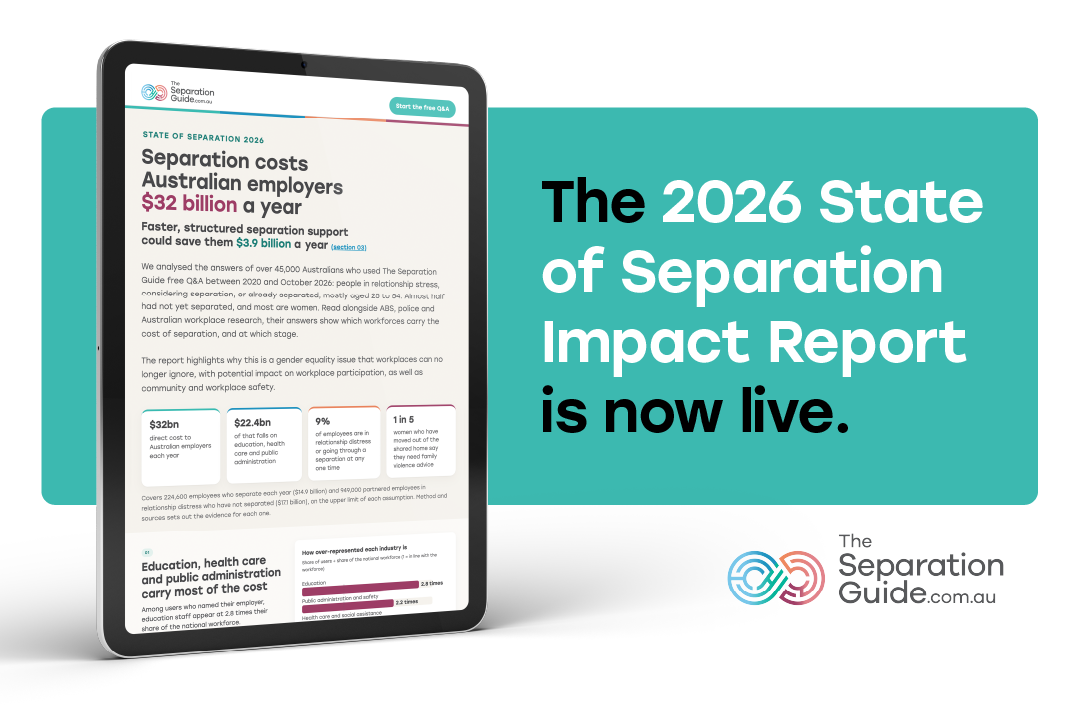
State of Separation 2026 report
SYDNEY, AUSTRALIA, November 27, 2026 /EINPresswire.com/ -- A report released today by The Separation Guide has revealed that separation costs Australian employers a staggering $32 billion each year, and that education, health care, and public administration account for 70 percent of this cost despite employing just 32 percent of Australian workers.
The “State of Separation 2026 report” analysed ABS, HILDA and Australian workplace research alongside 45,530 de-identified answers to The Separation Guide's free Q&A, given between 2020 to October 2026 by self-selecting respondents experiencing relationship conflict, considering separating, or already separated.
It found that about nine in every 100 employees are in relationship distress or going through a separation at any one time, including 224,600 employees who separate each year and 949,000 who report serious relationship problems but have not separated.
The $22.4 billion (70 percent) worth of costs borne by employers in education, health care, and public administration means staff in these industries are seeking separation help at about twice the rate as the broader workforce.
Education staff tops this, appearing at 2.8 times their share of the national workforce, followed by public administration and safety workers at 2.2 times, and health care workers at 1.9 times.
Each separating employee costs their employer an estimated $66,400 in lost productivity, time off and staff turnover, which is a cost of about $2.2 million a year for every 1,000 staff across the whole workforce.
However, prior data shows that structured support from The Separation Guide helped people settle their separation about five months (153 days) sooner than those who did not.
If this support was provided to all Australians seeking separation support now, resulting in the same reduction in time to settle, this could save employers across Australia $3.97 billion a year or about $269,000 for every 1,000 staff.
Other findings included:
Forty percent of newly separated people still lived with their former partner in 2026, up from 29 percent during the COVID years of 2020 and 2021. Among renters, the share rose from 18 to 33 percent, which the report notes could be attributed to national rents rising 41.2 percent in the five years to March 2026, according to Cotality.
Women are more than twice as likely as men to have started the separation (51 percent against 24 percent), but also more likely to carry a HECS-HELP debt (27 percent against 17 percent) and less likely to understand the value of the couple's combined assets (50 percent against 60 percent).
Women are over three times as likely as men to say they need family violence advice (16 percent against five percent).
According to The Separation Guide, recorded depression is highest at a stage colleagues may not know about before separation begins, which leaves workplaces carrying a cost they may not see.
Angela Harbinson, co-founder and CEO of The Separation Guide, said: "Separation is already in every workplace in Australia, usually in silence. The stress peaks while people are still deciding whether to leave, long before anyone at work is told, and that is exactly when the right support makes the biggest difference.
"Schools, hospitals and the public service carry most of this cost, so the opportunity to do better sits largely with government and the employers who keep essential services running. We want to work alongside them to make early, confidential separation support as normal as any other part of looking after people."
Caitlin Davies, Senior Leader and Advocate, Family Violence Prevention, Gender Equity and Systems Reform, said: “Women in this data were more than three times as likely as men to say they needed family violence advice. That matters because separation can be one of the most dangerous times for women experiencing family violence, particularly where there is coercive control or escalating abuse. We also know that abuse can continue well beyond separation through finances, children and other systems, which is why separation pathways need to recognise risk early, respond safely and connect women with the right specialist support.”
The full State of Separation 2026 report, including employer cost and savings calculators, is available at https://impact2026.theseparationguide.com.au/
If you or someone you know is affected by family violence, call 1800RESPECT on 1800 737 732. In an emergency, call 000. For crisis support, call Lifeline on 13 11 14.
# #
The Separation Guide (theseparationguide.com.au) is an Australian online separation and divorce platform. Its free Q&A helps people understand their situation and connects them with a network of independent mediators, family lawyers, and financial and wellbeing professionals. The Separation Guide works with employers, insurers and employee assistance program providers to fund separation support for their people. Its purpose is to make separation and divorce simpler, more manageable and less expensive. 45,530 people have been helped by the service.
Priyanka Dogra
Third Hemisphere
priyanka@thirdhemisphere.agency
Legal Disclaimer:
EIN Presswire provides this news content "as is" without warranty of any kind. We do not accept any responsibility or liability for the accuracy, content, images, videos, licenses, completeness, legality, or reliability of the information contained in this article. If you have any complaints or copyright issues related to this article, kindly contact the author above.
